

I’ve been asked to write about China, and I’m currently staring at a blank page. How to write about the enigma that is China. Where do you start? Maybe the size?
The 4th largest country in the world (9,596,960 sq km), bordering 14 countries. The rivers? The Yangtze, Yellow and Ob-Irtysh (me neither), not to mention the Mekong, Red, Pearl, Brahmaputra, Ganges & Indus. So far so good, but maybe not the most exhilarating writing.
Hmmmm. Let’s try population…
There are 1.42 billion people living in China – That’s 17.4% or the world population – not far off 1 in every 5 people in the world live there (India overtook them to take 1st place a couple of years ago, and China is slightly grumpy about it). The Chinese government officially recognises 56 ethnic groups speaking 297 living languages and dialects.
Nope. Still too many numbers for sparkling prose…
And maybe, that’s the thing. China is so vast, in every way, that writing about it as a whole entity is difficult and unwise. The Chinese certainly look at themselves (mostly) as being Chinese, but their heritage and customs are regional and local. A Hong Kong Cantonese speaker will eat, speak, think and act differently to a Mandarin speaker from Beijing.
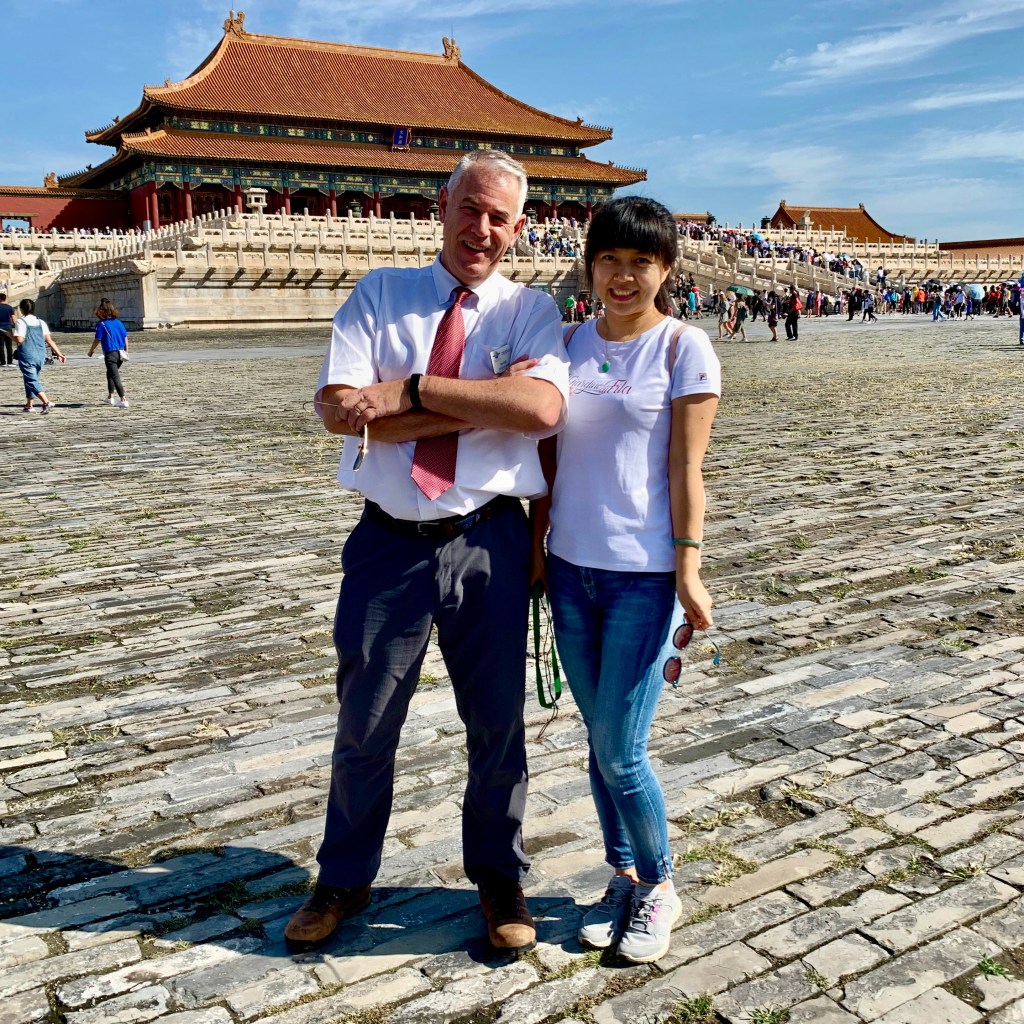
If you’re a real world traveller (if you’re reading this, you probably are) then China absolutely must be high on your list of places to visit. I’ve taken many Tours there over the years and never tire of visiting this extraordinary and baffling country. Before my first visit, my head was full of opinions and notions about China, based on a cocktail of second hand information from Western media (often rubbish), inexpertly blended with books, movies and occasional visits to Chinatown. Rarely had I talked to Chinese expats or nationals. There’s nothing quite like actually visiting a country to force you to recalibrate and reassess. China is so much in the news these days, one way or another, that it must be worth getting closer and trying to understand more of what is actually going on. China fell off the world during COVID and it is just starting to open up once more to Western visitors; there has never been a better time to visit. China has millions of tourists, but most are domestic or from neighbouring countries. Western tourists are around 2 – 3% of the total.
The high-speed rail network in the People’s Republic of China (PRC) is the world’s longest and most extensively used. It has become so in the space of about 20 years. The trains are fast, very comfortable and air-conditioned. A Stewardess in an immaculate uniform will greet you at the door for boarding. My favourite activity on board, by far, is visiting the Café car. Clean and comfortable, well staffed and welcoming, it retails an extensive range of snack and meals that that are… completely impossible to identify! There is no English lettering and the images are… unhelpful. It’s lucky dip time and some you win, some you lose.

GRJ currently operate two different tours to China, the Classic, Treasures of China & Yangtze River Cruise and the (shorter) Discoveries tour, Highlights of China. Both cover the primary things that you need to see on a first visit – Beijing with the Forbidden City, Tiananmen Square and Great Wall, Xi’An for the Terracotta Army, Chengdu for Pandas and Shanghai for the Bund. Both also include a cruise on the Yangtze River through the Three Gorges and the associated Dam. So far I haven’t mentioned Chongqing, which we pass through briefly, and which is (arguably) the largest city in the world at well over 30 million people. For me, the longer, Classic, tour is the better. I figure if you’re going all that way you might as well spend as much time as possible there; but that’s just me, other people have different time and budget constraints and that’s just fine.
Beyond visiting the must-see sites, is there an opportunity to learn more about China and its’ people? Definitely. In each of the cities we have a Local Guide to look after us, and each, to some degree reflects the nature of where they live. Beijing, more formal, aware of its’ significance; Shanghai, more cosmopolitan and easy going, Xi’An is closer to its’ historical significance and Chengdu is the most youthful and exuberant. In a country as crowded as China, it’s hard not to mix with the locals. A visit to Tiananmen Square is an introduction to the incredible number of people out on the street – and they’re usually going in the opposite direction to you! Thousands of Chinese tourists make the pilgrimage to Tiananmen, often each group wearing an identically coloured baseball cap. The square contains the Monument to the People’s Heroes, the Great Hall of the People, the National Museum of China, and the Mausoleum of Mao Zedong (Chairman Mao). A visit is a pilgrimage and a rite of passage for the Chinese. As a Westerner, you will be stared at, sometimes discretely, sometimes not. Most people haven’t seen a European in real life before, living as they do in small towns and villages away from the tourist pathways. I can’t begin to count how many times I’ve been photographed with random groups of people simply because I’m a novelty. Presumably I’ve been projected, many time, larger than life on to a Village wall somewhere for the “What I did on my Holiday” slideshow. Talk to children and they may want to touch the hairs on your arm out of curiosity, or comment on your nose size (one Mandarin word for Westerners is “Big-Noses”).
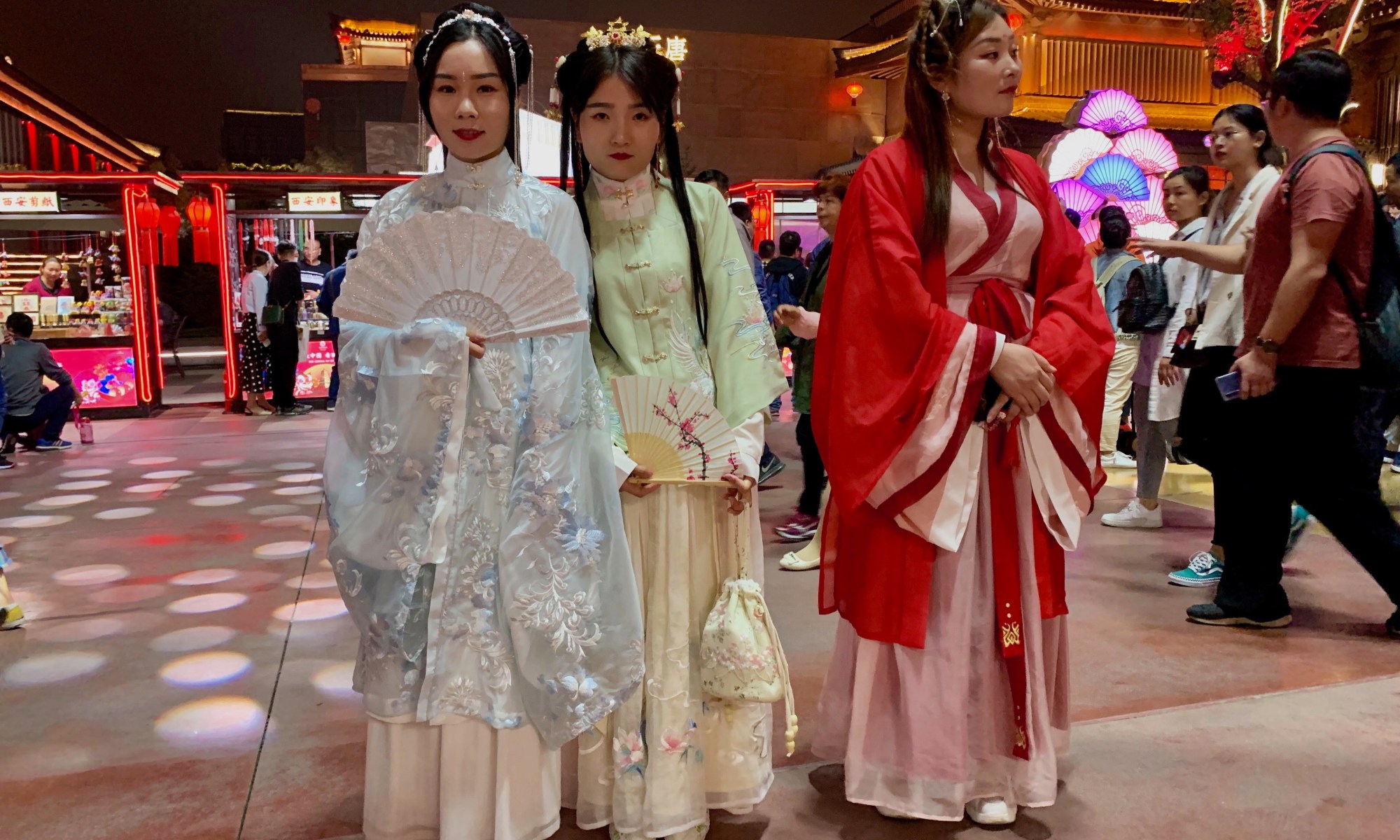
In Xi’An, you may walk along the astonishing Datang Ever Bright City road , filled with colourful lights and street shows where fashionable young people enjoy dressing in traditional Tang Dynasty clothes for their own amusement.
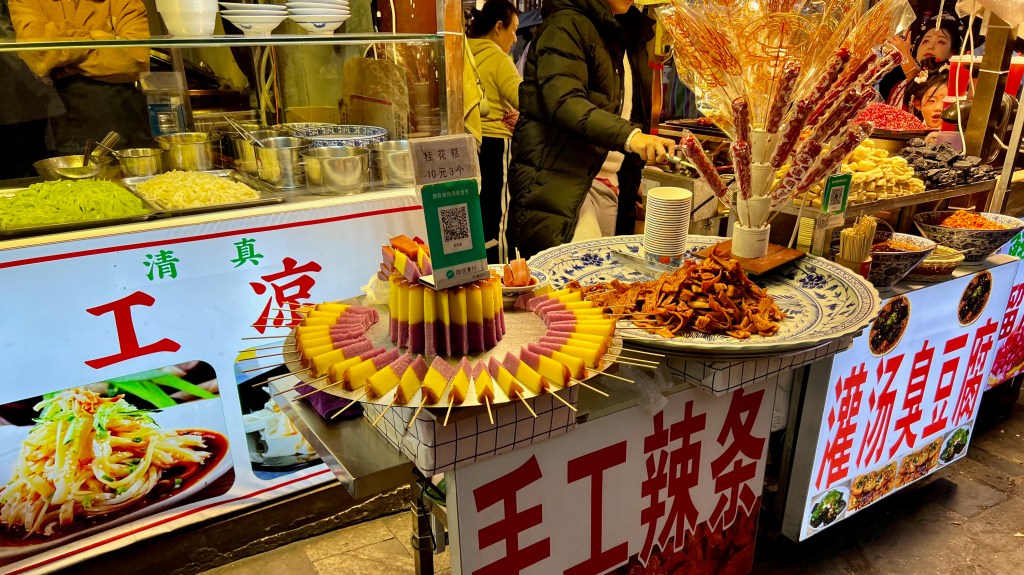
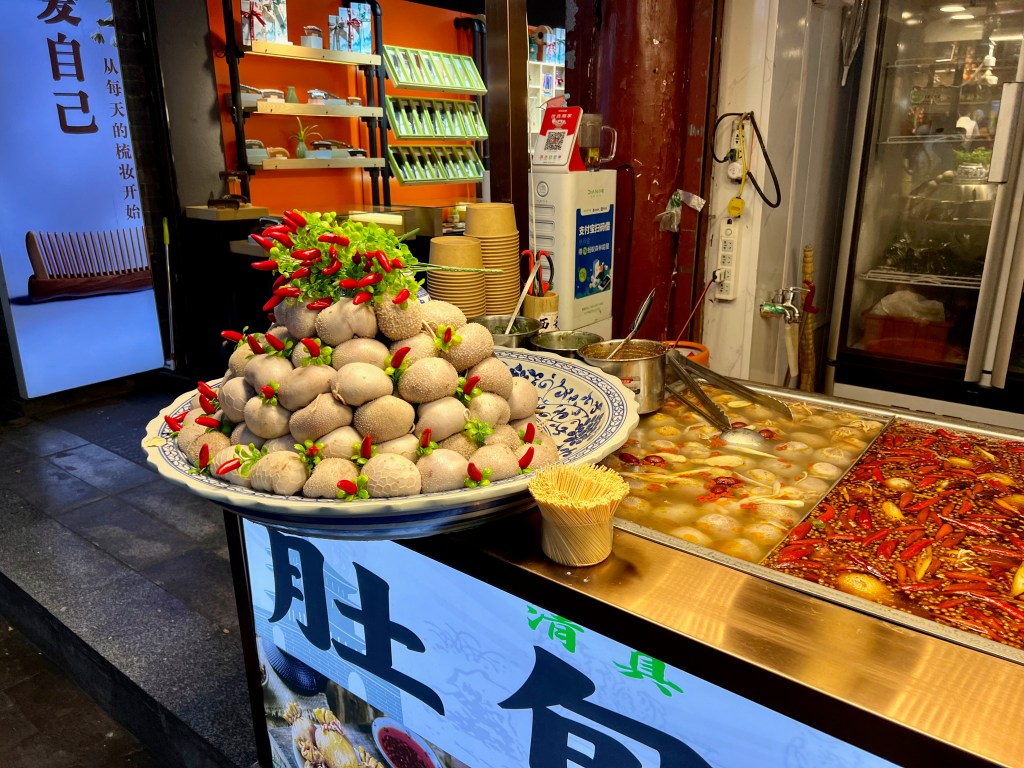
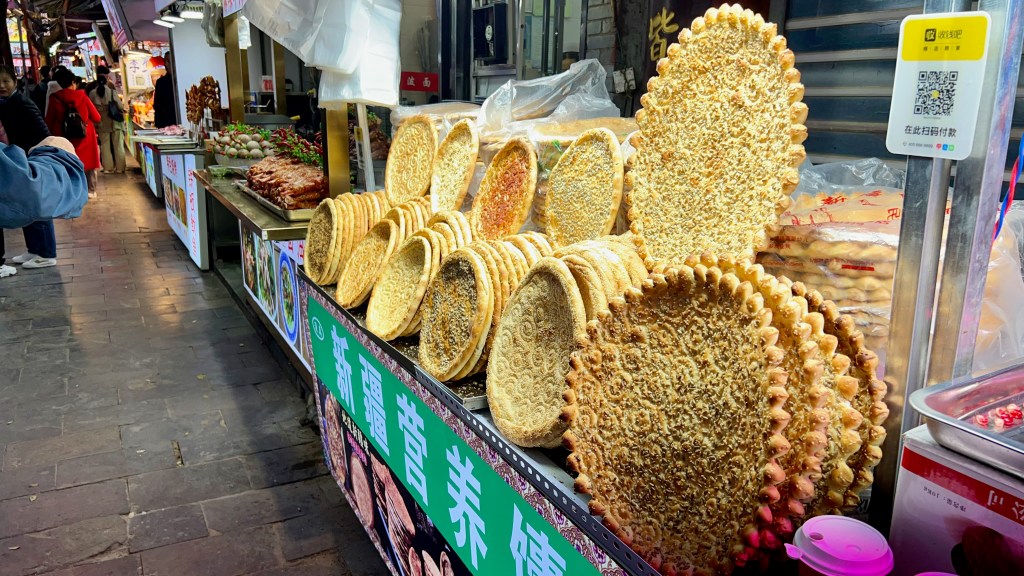
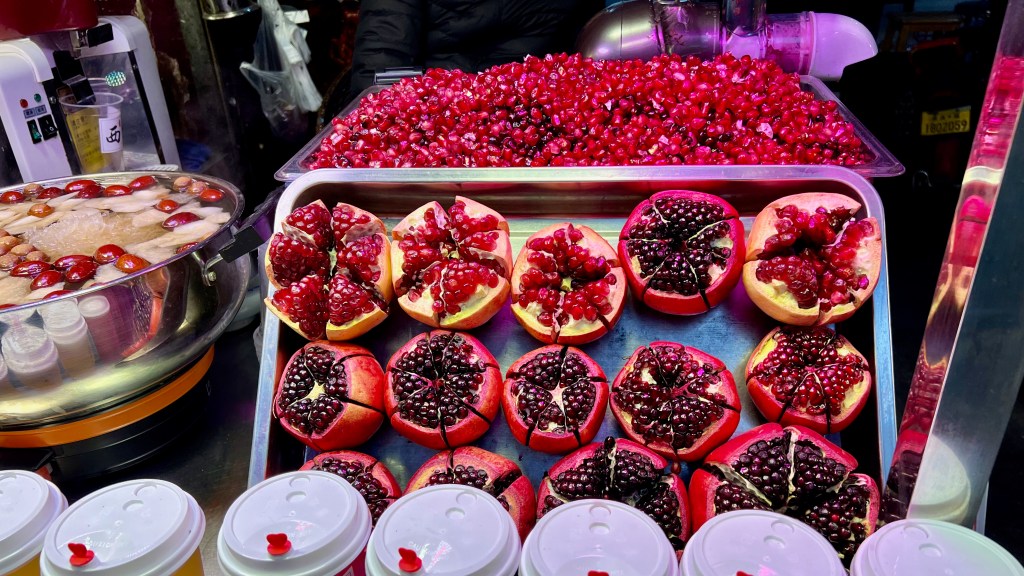
We may walk along Huimin Street (The Muslim Quarter), home to the Hui ethnic people, where hawkers vie to sell you brightly coloured foods that defy description. The Chinese eat almost everything you can think of, although Western bread, milk, smelly cheese and uncooked or under-cooked food is rarely popular.
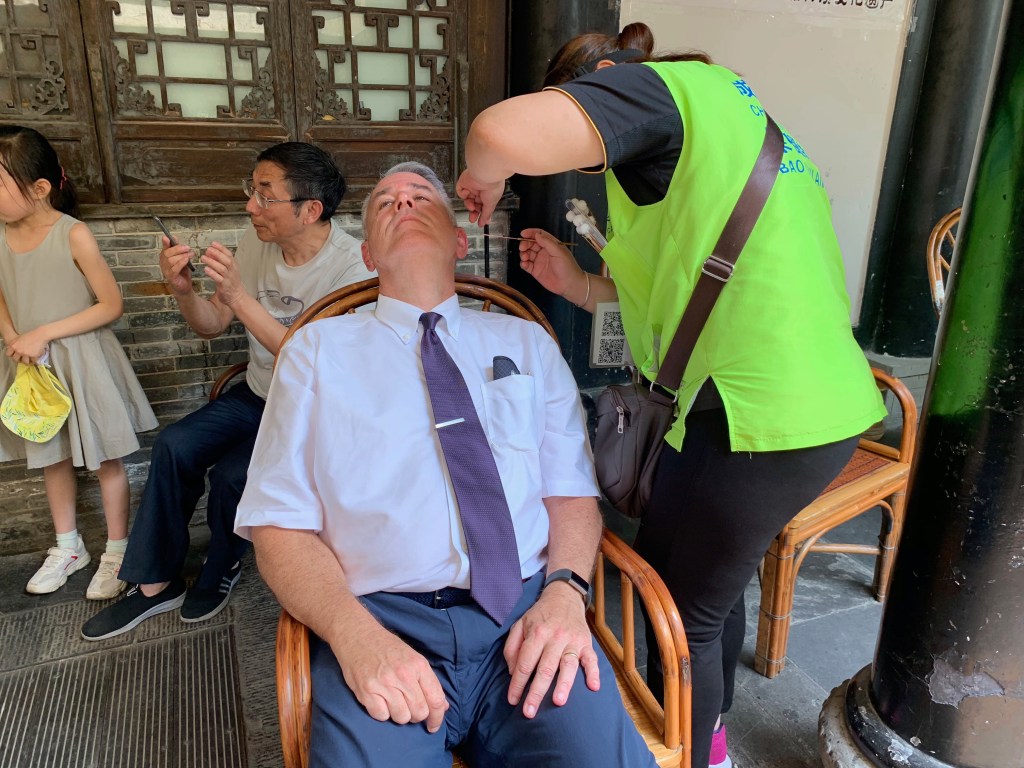
In Chengdu, you can enjoy an ear cleaning massage from the comfort of your chair in a Tea House, while watching hundreds of elderly Chinese drinking endless cups of Tea (Cha) and playing ferociously competitive Mah-Jong games. Once armed with refreshed and glowing ears, it’s a short walk to People’s Park where the Matchmakers work in the open air. Paper resumés are tied to the railings advertising the relative merits of boys and girls looking for a marriage partner; anxious parents wait nearby, ready to answer questions. Small armies of Pensioners dress in their finery for open-air Western style Ballroom dancing classes and competitions under the trees.
At Mutianyu you will usually meet large groups of 10 – 15 year old Chinese schoolchildren, identically dressed in white tracksuits on school excursions to see the Great Wall. They’re kids, so they’re noisy and excitable and potentially irritating – but they are also kids learning English and they’ve never met English people before. You can have wonderful conversations with them, although some of their English phrases are a little unexpected – “Do you have an umbrella?”, “Please say Hello to the Queen” and “Is the English weather clement today?” All stopped me in my tracks. There’s also the now traditional exclamations of “Manchester United!”.
So, a China Tour is not just about seeing, things; It’s also about meeting people and I firmly believe that the more people meet the more that they understand. It’s worth underlining, again, in red – China is a Communist One Party state. That means there are limitations on what you can do and say while you are there. If you can’t deal with that, then don’t go. Internet access is tightly controlled and Gmail, Social Media and News media access will be blocked, even with a VPN. That said, a visit to China raises some interesting questions for Westerners, that challenge our assumptions. Capitalism = Good, Communism = Bad is something that I’m comfortable leaning into, but the reality is far more nuanced than that. Each side has something to learn from the other. Working out what can be learned is your challenge as a visitor, and one that you’re better equipped to make when you’ve actually been there.
How I Lost Face over Ice Cream in China
My first Tour ever to China. We returned to our hotel from the Great Wall and I had to distribute various purchased souvenirs to my clients (Official Group Photos, Certificates etc.). For this 10 minute process I set up on a table in the lobby together with my Local Guide, Lily and set to work with my clients. Shortly, the Hotel Manager appeared, flanked by two subordinates and a quiet conversation with Lily ensued.
“At 6 o clock” she translated “this table is used to set up an ice cream fridge for hotel guests. It is now 6:01pm and he wants his table back”.
“Well…” I said to Lily “Tell him he’s fresh out of luck for the next few minutes. I’ve got 30 people staying for 3 nights in this hotel, so I have a bit of clout and if I need to use this table for another 5 minutes then that’s what I’ll be doing. Tell him to come back in Five”.
Hesitantly, and reluctantly, Lily relayed this back to the Manager. It didn’t look like I was making too many friends on this one. Lily came back and repeated his earlier request to me.
“What is his problem?” I asked “Why? Why does he need this table right now?”.
There was the sort of absolute silence where, with a sinking feeling, you realise that things aren’t quite going as well as you had hoped. It turned out that he understood little bit of English after all. He turned his back and stalked off in a miasma of fury. Lily, always charming and patient with imbecile foreigners like me, helped out.
“In China…” she explained” We never ask… Why? – We just do as we are asked”. Also, in declining his request, I had caused him to Lose Face in front of his subordinates, and in becoming irritated, I had also Lost Face myself.
I wasn’t arrested and I was allowed to remain in the hotel, my Visa was renewed and I was allowed to return to China frequently, so things worked out in the end. I’ve worked with Lily many times since, especially now that she has educated me as to how to be a better Tour Manager. Part of this education was achieved by presenting me with specially created Tea and instructions to drink it daily.
“Make you good and proper Chinese man” she said, “…also good for eyesight, intellect, and testicles”.


